
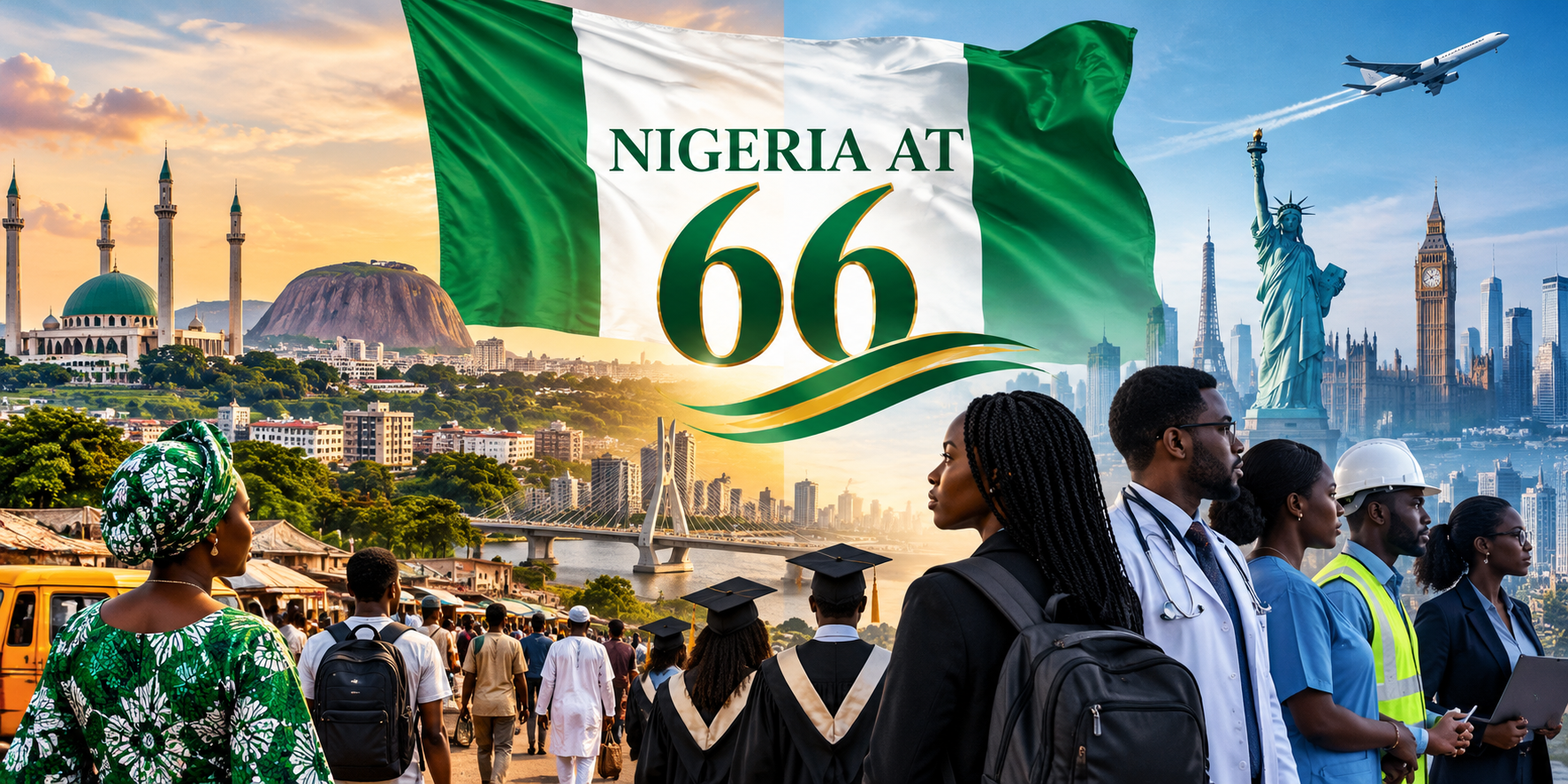
Nigeria at 66: What Are We Really Celebrating?
On October 1, 2026, Nigeria marked sixty-six years of independence from British colonial rule. There were celebrations, official speeches, congratulatory messages, and the familiar promises of a brighter future.
The occasion was meant to inspire national pride and remind Nigerians of how far their country has come since 1960. But as I reflected on the anniversary, one uncomfortable question kept returning to my mind:
What, exactly, are we celebrating?
I love Nigeria. I love its people, its culture, its warmth, its humor, and the extraordinary determination of Nigerians to succeed, even when faced with great challenges. But loving a country doesn’t mean ignoring its failures.
Sometimes, the deeper the affection, the more painful it becomes to watch a place that once held so much promise struggle under the weight of problems that should have been addressed decades ago.
I have lived outside Nigeria for nearly four decades, and although I have built my life elsewhere, my connection to the country remains. Yet today, I find myself asking questions I never imagined I would be asking.
How did a nation so richly endowed with natural resources, human talent, and economic potential reach a point where millions of its citizens struggle to meet their most basic needs?
How did we become a country where so many educated young people see emigration as their best hope for a decent future? And perhaps the saddest question of all:
Will Nigeria ever become the country we once believed it could be?
The Nigeria I Knew and the Life I Built Abroad
I was born in London, but my parents returned to Nigeria when I was a child. It was there that I spent much of my childhood and early adult life, made friends, attended school, and began imagining the future I wanted for myself.
Nigeria was home.
I went on to university, studied microbiology for six years, and earned my master’s degree at the age of twenty-four. Like most young graduates, I wanted a fulfilling career, financial stability, and the opportunity to apply my education effectively.
I believed that studying diligently and obtaining advanced qualifications would give me a reasonable chance of building that future. However, at twenty-nine, I made the difficult decision to leave Nigeria and return to London, the city of my birth.
At the time, I was working as a microbiology lecturer at the University of Nigeria, Nsukka. But I was becoming increasingly frustrated with the state of the university system.
Industrial strikes repeatedly disrupted academic activities, salaries were poor, and the uncertainty surrounding the profession made it difficult to envision a fulfilling future. Eventually, I reached a point where I felt I had had enough.
Leaving was not an easy decision. Nigeria was home, and I had already begun establishing myself professionally. But I was young, ambitious, and unwilling to spend the best years of my working life trapped in a system that seemed incapable of improving.
I wanted stability, professional growth, and the opportunity to earn a decent living from the education I had worked so hard to acquire. So I packed my bags and returned to London, hoping to build a better future.
What saddens me most today is that nearly four decades later, the very problems that frustrated me then have not only persisted but, in many respects, have become considerably worse.
The Nigeria I left had its share of political instability, economic difficulties, and institutional failures, but I remember a country where we could generally travel from one city to another without the constant fear of being robbed or kidnapped for ransom.
I do not remember university cult violence or highway insecurity being the pervasive concerns they have since become. We moved around with a sense of freedom and personal safety that many Nigerians can no longer take for granted.
I am not suggesting that Nigeria was perfect in those days. Far from it. After all, its problems were serious enough to make me abandon a university teaching career and leave the country.
But I never imagined that almost forty years later, I would look back at the Nigeria I left and realize that, despite all its shortcomings, it felt considerably safer and more hopeful than the country I see today.
About five years after returning to London, I moved to the United States. Despite my academic qualifications and teaching experience, I was unable to secure employment in microbiology. I eventually returned to school, retrained as a nurse, and built a career that would span more than three decades.
Nursing has given me a rewarding career, allowed me to support myself and my family, and brought me into the lives of people during some of their most vulnerable moments. I am grateful for everything the profession has given me.
But I have never stopped wondering how different my professional journey might have been if Nigeria had provided the stability and opportunities I needed to remain. I sometimes reflect on the young woman who spent six years studying microbiology, convinced that she was preparing for a particular future.
I wonder how differently my life might have unfolded if I had been able to pursue that career in Nigeria. I have now lived most of my life abroad and have returned to Nigeria to visit on about five occasions.
My experiences have taught me that starting over in another country is often more complicated than people would ever imagine. Qualifications do not always transfer easily. Professional experience may not receive the recognition one expects.
Some immigrants must retrain, accept jobs beneath their qualifications, or spend years establishing themselves in a foreign land. Behind many successful Nigerians living overseas are stories of financial sacrifice, loneliness, professional disappointment, and the difficult process of adapting to unfamiliar societies.
There is also the emotional cost of distance. Many Nigerians living abroad have lost parents and other loved ones while thousands of miles away.
Some of us were unable to return in time to say goodbye. I know that pain personally. Since leaving Nigeria, I have lost both of my parents unexpectedly, at different times, while living abroad.
No amount of professional success can make up for those final moments we never had or the goodbyes we never got to say. These sacrifices are often overlooked in the glowing stories of Nigerians who have made successful lives abroad.
And they are worth remembering whenever someone casually accuses Nigerians in the diaspora of abandoning their country.
Sixty-Six Years Should Be Long Enough
Sixty-six years is an entire lifetime. A child born on October 1, 1960, when Nigeria became independent, would now be sixty-six years old.
That child may have grown up, received an education, raised children, and become a grandparent. Sixty-six years should be sufficient time for a country to make substantial progress in providing the basic necessities of modern life.
I’m not talking about luxurious government buildings, extravagant ceremonies, or impressive motorcades. I am talking about reliable electricity, clean running water, decent roads, functioning hospitals, and schools where children can learn without constant disruption or fear.
I’m talking about the ability to travel from one town to another without worrying about kidnapping and the reasonable expectation that a public employee will receive a salary when it is due.
Are these unreasonable expectations after more than six decades of independence?
Nigeria possesses enormous natural resources, including oil and gas, as well as fertile land and a large population of talented, industrious people. Nigerians have distinguished themselves internationally in medicine, science, technology, business, education, literature, music, and entertainment.
Their achievements demonstrate what Nigerians are capable of when opportunities exist. So why does a country that produces so much talent continue to struggle with services that are fundamental to national development? That contradiction is one I find increasingly difficult to accept.
When Citizens Must Provide Their Own Basic Services
Consider electricity, perhaps one of the most persistent symbols of Nigeria’s failure to translate its resources into dependable public infrastructure. In 2026, reliable electricity remains beyond the reach of millions of Nigerians.
For many households and businesses, power interruptions are not occasional inconveniences but recurring disruptions that shape everyday decisions. A student trying to prepare for examinations may have to study without adequate lighting.
A small-business owner may spend a substantial portion of earnings on generator fuel. A family storing perishable food must worry about whether the electricity supply will last long enough to preserve it.
Businesses that should be investing in expansion and employment instead devote scarce resources to producing their own power. What makes the situation especially frustrating is that the problem has persisted for decades.
We are not discussing a newly independent nation still finding its footing. Nigeria has had sixty-six years to develop and maintain the infrastructure necessary for a modern economy.
Electricity is only part of the story.
In many communities, households must arrange their own water supply by drilling boreholes because dependable municipal water services are unavailable. Those who can afford alternative power systems purchase generators, inverters, batteries, or solar installations.
Some communities even contribute money to repair roads that public authorities should maintain. In effect, citizens pay taxes and then pay again to provide services that governments are expected to deliver.
Of course, no government can provide every service perfectly, and infrastructure challenges are not unique to Nigeria. But there is something fundamentally wrong when self-provision becomes the normal way of life rather than an occasional necessity.
If ordinary people must continually arrange their own electricity, water, road repairs, and other essential services, what are they receiving in return for the taxes they pay and the public resources managed in their name?
This is not merely an inconvenience. It is a question of accountability.
The Fear of Returning to a Country I Once Called Home
Of all the changes that trouble me about Nigeria, the deterioration of security is perhaps the most personally distressing. There are still people I would love to visit and places I would like to see again.
There are memories associated with particular towns, streets, schools, and communities that remain precious to me. Yet when I contemplate another visit to Nigeria, excitement is no longer the only emotion I feel.
There is fear.
I worry about reports of people abducted while travelling on highways, families receiving ransom demands, and innocent citizens becoming victims of violent crime. I think about parents who send their children to school without the reassurance that they will return safely and families whose ordinary journeys end in unimaginable terror.
For those of us living abroad, these accounts are deeply unsettling. I cannot imagine the anguish of receiving a telephone call informing me that a loved one has been kidnapped and that an enormous sum of money must be raised to secure their release.
Where is an ordinary family supposed to find millions of naira at short notice? And even if the money is paid, what guarantee is there that the victim will return safely?
What I find particularly disturbing is that some Nigerians returning home from abroad now feel the need to hire armed security escorts simply to travel between destinations. Think about what that says about the state of security in a country when people feel they must arrange personal armed protection just to visit family, attend an occasion, or travel from the airport to their hometown.
I remember a time when we could travel around Nigeria without routinely contemplating such precautions. The idea that I might now need armed guards to move around a country where I once travelled freely is something I find profoundly sad.
Returning home should be a joyful experience, not an exercise in assessing security threats and arranging protection.
I recognize that Nigeria is a large and diverse country and that security conditions differ considerably between regions. Millions of Nigerians continue to work, travel, raise families, and live ordinary lives.
It would be unfair to portray the entire country as one enormous danger zone. But acknowledging that reality does not diminish the seriousness of kidnapping, violent crime, and the fear they create.
A government has a fundamental responsibility to protect its citizens. When people must carefully assess the dangers of travelling between cities, attending school, running businesses, or visiting relatives, something has gone terribly wrong.
For Nigerians in the diaspora, the consequences are particularly painful. We want to return, reconnect with our communities, and revisit the places that shaped us. Yet many of us must weigh those desires against genuine concerns about personal safety.
I never imagined that I would reach an age when returning to the country where I grew up would inspire as much anxiety as anticipation. That is a sad reality to confront.
Healthcare: A Matter of Life, Death, and Dignity
Nigeria’s healthcare challenges are especially close to my heart because I have spent more than thirty years working as a nurse. I know from experience that no healthcare system is perfect.
Here in the United States, patients struggle with expensive medical bills, insurance complications, and unequal access to care. There are serious shortcomings even in wealthy countries.
Nevertheless, people should reasonably expect that when they become seriously ill, they will have access to competent medical professionals, functioning facilities, essential equipment, and timely treatment.
Nigeria has excellent doctors, nurses, pharmacists, and other healthcare professionals. Many are extraordinarily dedicated and continue caring for patients under difficult circumstances. The problem is not an absence of professional talent.
The problem is that too many healthcare facilities lack the resources, staffing, equipment, and institutional support necessary to deliver consistently reliable care. For many families, the cost of treatment is another formidable obstacle.
Imagine becoming seriously ill and worrying whether the nearest hospital has the equipment needed to treat you. Imagine facing a medical emergency only to discover that the required service is unavailable or unaffordable.
For me, such a scenario is more than a hypothetical concern. One fateful morning late in 2016, shortly after breakfast, my mother suddenly began clutching her chest. She died unexpectedly shortly thereafter.
To this day, I cannot help wondering whether her life might have been saved if she had had access to a well-equipped emergency medical response system, like the one we have here in the United States, where an ambulance and trained paramedics can be dispatched to provide immediate care.
Of course, I will never know whether prompt medical intervention would have changed the outcome. But that uncertainty is itself painful.
When someone has a sudden medical emergency, every minute can be important. No family should be left wondering whether a loved one might still be alive if timely emergency care had been available.
My years in nursing, particularly in hospice care, have taught me how vulnerable people become when illness takes away their independence. At those moments, patients and families need reassurance that competent help is available and that their dignity will be respected.
It troubles me that so many Nigerians cannot rely on that reassurance. I sometimes ask myself what would happen if I became seriously ill while visiting Nigeria.
Would I receive the treatment I needed?
Would help arrive in time?
Would the appropriate equipment and trained personnel be available?
Those are questions I never expected to be asking about the country where I spent so much of my early life. And they are questions no citizen should have to ask with such uncertainty.
Education, Unemployment, and a Generation Looking for the Exit
If any group of citizens should give Nigeria hope for the future, it is its young people.
I remember what university education meant to me and how much effort went into obtaining my qualifications. I also know the enormous sacrifices many Nigerian parents make to ensure that their children receive a university education.
Unlike in the United States, where student loans have long provided an established means of financing higher education, Nigerian families have traditionally had to shoulder much of that financial burden themselves.
Although Nigeria has recently introduced a federal student loan program, the reality is that many parents still struggle to pay tuition-related expenses, accommodation costs, transportation, and other necessities, often making considerable personal sacrifices to give their children a better future.
University should provide young people with the knowledge, skills, confidence, and opportunities needed to build productive lives. Instead, Nigerian higher education has endured years of funding difficulties, industrial disputes, interruptions to academic calendars, and other institutional challenges.
For students, these problems can turn what should be a predictable educational journey into years of uncertainty.
There are also concerns about campus violence and cult-related activities. Parents send their children to university to learn, not to live in fear.
But even after overcoming those obstacles and graduating, many young Nigerians face another difficult question:
Where are the jobs?
What happens when a young person spends years acquiring qualifications, only to discover that meaningful employment is scarce and that the future remains uncertain?
I experienced that frustration myself. After earning my master’s degree in industrial microbiology, I had hoped to build a career in that field. But despite my qualifications, I was unable to secure employment in the area I had spent years preparing for.
I eventually accepted a position as a microbiology lecturer at the University of Nigeria, Nsukka – not because teaching was my chosen career, but because the opportunities I had hoped for in industrial microbiology were simply not available to me.
Although I was grateful to have a professional position, it was not the career I had envisioned. And with frequent university strikes, poor remuneration, and continued uncertainty, my frustration only grew. Eventually, I decided to leave Nigeria and return to London.
That was nearly four decades ago.
What troubles me today is that so many young Nigerians are still facing similar disappointments. They invest years in education, graduate with qualifications and ambitions, and then discover that the opportunities they worked so hard to prepare for are either limited or nonexistent.
It is hardly surprising that so many begin looking beyond Nigeria’s borders for a future they can no longer imagine building at home. Discouragement is understandable. So is the desire to look elsewhere.
Brain Drain & The ‘Japa’ Phenomenon
The popular Nigerian expression “japa” has come to represent that determination to leave in search of better opportunities. Doctors, nurses, engineers, scientists, technology professionals, and other skilled workers are among those seeking futures abroad.
Some people describe the phenomenon as a lack of patriotism.
I disagree.
Leaving one’s country is not necessarily an act of rejection. Often, it is an act of self-preservation, an attempt to secure a better life for oneself and one’s family.
Why should a doctor accept inadequate working conditions indefinitely to demonstrate loyalty to Nigeria?
Why should an engineer remain unemployed when professional opportunities exist elsewhere?
Why should parents feel guilty about wanting to raise their children in a safer environment?
Citizens have responsibilities to their country, certainly. But governments have responsibilities to their citizens.
People should not be expected to sacrifice their livelihoods, security, and children’s futures simply to compensate for decades of failed public policy.
The Diaspora Has Not Abandoned Nigeria
One accusation that particularly troubles me is the suggestion that Nigerians who have emigrated have somehow abandoned their homeland. For many of us, this is simply not the case.
Nigerians abroad continue to support their relatives at home, fund education, pay medical expenses, assist with housing, invest in businesses, and contribute to their communities in Nigeria. Remittances from overseas represent a substantial financial lifeline for many households.
But there is a limit to what individuals can accomplish.
I can send money to help a relative pay a hospital bill, but I cannot build a national healthcare system. I can contribute towards a generator, but I cannot fix the country’s electricity supply. I can help repair a road in a community, but I cannot develop and maintain the national road network.
Those responsibilities belong primarily to government. Diaspora support is valuable, but it should never become an excuse for public institutions to neglect their obligations.
The Nigerian Diaspora: Our Contributions Matter, but What About Our Votes?
There is another issue that deserves serious attention: the political voice of Nigerians living abroad.
Although Nigerians overseas are encouraged to invest in their homeland and contribute to national development, the country still lacks a general system that enables eligible citizens to vote from abroad in national elections. I find that contradiction difficult to justify.
If our financial contributions matter, why should our political participation be so limited? If our knowledge, investments, and professional experience are welcomed, should our voices not also count when decisions are made about the country’s leadership?
Implementing diaspora voting would require careful planning, safeguards, and electoral reforms. I recognize that it is not a simple administrative undertaking, but difficulty should not be mistaken for impossibility.
If a nation truly values its diaspora, it must figure out how to give those citizens a real voice in its democratic future.
Corruption, Broken Promises, and the Failure of Accountability
It is impossible to discuss Nigeria’s persistent problems without confronting corruption and the wider failures of governance.
For decades, governments have allocated public money to infrastructure, healthcare, education, electricity, security, and other essential services. Yet ordinary citizens have often experienced improvements that fall far short of what those investments should have achieved.
Reports of misappropriated public funds, wasteful expenditure, abandoned projects, and inadequate oversight have become depressingly familiar. Every failure has a human cost.
A road that remains dangerous can contribute to preventable injuries and deaths. A hospital without essential equipment may be unable to treat a patient in an emergency. A neglected school deprives children of opportunities they may never recover.
Corruption is therefore not simply about money disappearing from public accounts. It is about the lives affected when resources intended for the public benefit fail to reach the people who need them.
I do not believe every Nigerian politician or public servant is corrupt. There are undoubtedly honest and capable individuals who genuinely want to serve their communities.
But good intentions are not enough when systems repeatedly fail to enforce accountability. Nor can Nigeria’s problems be blamed exclusively on the current administration. These failures have accumulated under different governments, political parties, and generations of leadership.
Recognizing that history, however, does not absolve those currently in power of responsibility. Every administration inherits challenges. Every administration also has an obligation to confront them.
During the sixty-sixth independence anniversary, President Bola Tinubu spoke optimistically about Nigeria’s economic future. I would welcome genuine prosperity for the country. I want businesses to thrive, employment opportunities to expand, and families to experience meaningful improvements in their standard of living.
But Nigerians have heard promises of economic renewal many times before. Speeches about progress mean little to a mother who cannot afford enough food for her children. Economic forecasts offer limited comfort to a graduate who cannot find work.
And assurances about national security do not erase the grief of families who have lost loved ones to violence. Progress must be measured not only by government announcements or economic indicators but also by improvements in the daily lives of ordinary citizens.
Can families afford essential goods?
Are children receiving a decent education?
Can patients obtain treatment?
Are roads safer?
Is electricity more reliable?
Do young people have realistic opportunities to build their futures?
These are the questions that matter. Until people can see and feel meaningful change, promises of a brighter tomorrow will continue to sound painfully familiar.
Loving Nigeria Does Not Mean Defending Its Failures
Sometimes I ask myself whether I have lost hope in Nigeria. The answer is complicated.
I have certainly not lost faith in Nigerians. Their intelligence, resilience, creativity, enterprise, and determination continue to impress me.
Wherever I look, I see Nigerians achieving remarkable things in circumstances that allow their talents to flourish. That makes me proud.
But I have become deeply disappointed in the way the country has been governed. And I believe those two feelings can exist together.
It is possible to love your country while being angry about its failures. It is possible to celebrate the achievements of its people while questioning the decisions of its leaders.
It is possible to cherish your heritage without pretending that everything is fine. Indeed, I would argue that genuine patriotism sometimes requires the courage to ask uncomfortable questions.
What concerns me is the tendency to celebrate Nigerian resilience as though it were an adequate substitute for effective governance. Nigerians are extraordinarily resourceful, but they should not have to be endlessly resourceful just to survive.
They should not have to provide their own electricity, water, security, and other basic necessities while being told to remain patient and hopeful. Resilience is admirable. It should not become an excuse for government failure.
I want Nigeria to succeed. I want public officials held accountable, public resources managed responsibly, and young people given meaningful reasons to remain in the country.
I want to see a Nigeria where people can work, raise families, receive healthcare, and grow old with some measure of dignity and peace. After sixty-six years of independence, surely that is not asking for too much.
What Independence Should Really Mean
When Nigeria gained independence in 1960, it represented a moment of enormous hope. Nigerians would have the opportunity to govern themselves, determine their national priorities, and shape the country’s future.
That achievement deserves recognition, and it always will. But political independence was supposed to be the beginning of something greater.
Independence should mean more than possessing a national flag, an anthem, and a government of our own. It should mean that ordinary citizens have a fair opportunity to live decent, productive, and secure lives.
Children should be able to attend school safely. Young adults should have realistic prospects of employment. Parents should be able to provide for their families.
People who become ill should have access to medical care. And older citizens should be able to spend their remaining years without constant fear of poverty, violence, or neglect.
These are not extravagant privileges reserved for wealthy societies. They are fundamental goals that any serious government should be working to achieve for their people.
When millions of people continue to struggle for those basic necessities after more than six decades of self-government, we must ask whether the promise of independence has truly been fulfilled.
That question should not be dismissed as unpatriotic. It should be at the center of our national reflection.
Will I Ever See the Nigeria I Once Hoped For?
I left Nigeria at twenty-nine and have spent the decades since building my life in Britain and the United States. I have raised a family, established a career, and created a home far from the country where I spent so many formative years.
For that life, I am grateful.
Yet there is something about the place where you grew up that remains with you for a lifetime. The memories of friends, familiar streets, family gatherings, cultural festivities, the food, and the people who helped shape the person you became remain part of your identity.
Time and distance do not erase those connections. What saddens me now is that, when I reflect on Nigeria, I increasingly feel fear and uncertainty alongside those memories.
Fear of travelling on the roads.
Fear of becoming seriously ill without access to dependable medical care.
Fear of falling victim to the insecurity that has become such a troubling part of the country’s story.
I never imagined that after spending so many years abroad, I would be questioning whether it would be safe or sensible to return permanently to a country that once felt so familiar. That is what makes Nigeria’s sixty-sixth independence anniversary so bittersweet for me.
It is not that Nigeria has achieved nothing. The country has produced remarkable people, made important contributions to the world, and demonstrated extraordinary potential.
It is that I know how much more it could have been. And I cannot ignore the millions of Nigerians who are still waiting for the security, opportunity, and dignity that independence was supposed to make possible.
So when I ask, “Nigeria at 66: What are we really celebrating?” I am not asking because I have turned my back on Nigeria.
I am asking because I remember what it meant to call that country home. Because I care about the people who still live there.
And because I hope that one day Nigerians will be able to celebrate independence not merely with flags, ceremonies, and political speeches, but with the confidence that their country is finally working for them.
I don’t know if I’ll live long enough to see Nigeria become that kind of country.
But I would dearly love to.